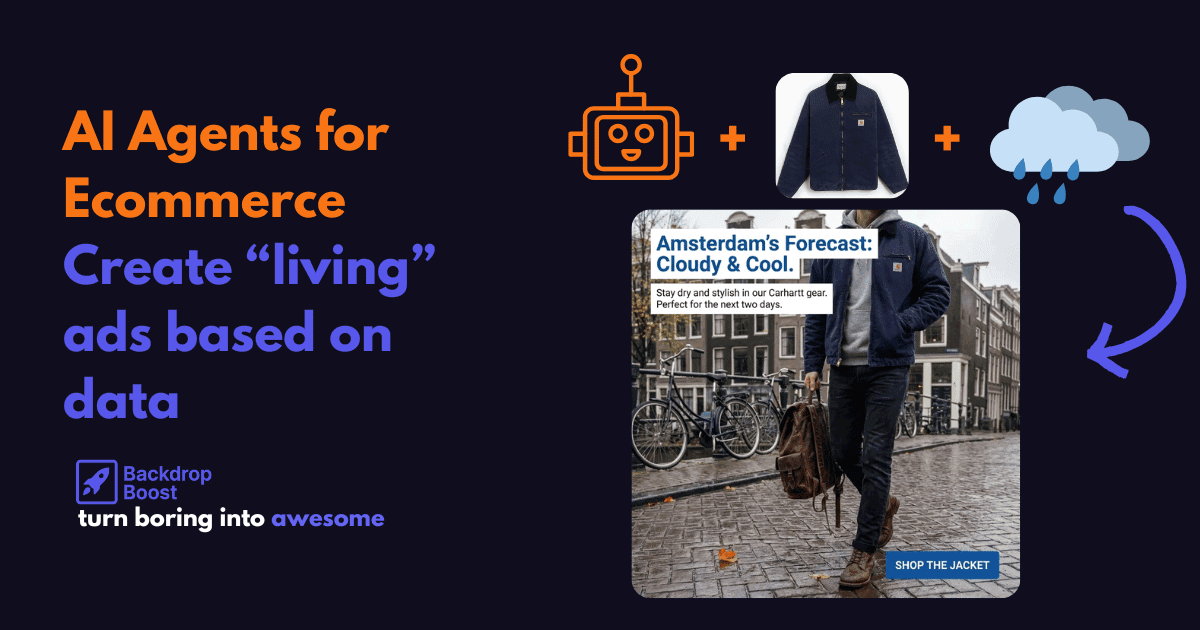
AI Agents for E-commerce: How Live Data Creates 'Living' Ads
Learn how AI agents are transforming e-commerce marketing by tapping into live data like weather forecasts. We built an agent that browses Google Search, selects products automatically, and generates contextually perfect ads in real-time.
🤖Explore this article with AI
Get AI-powered summaries, insights, and analysis from top AI platforms. Each platform offers unique perspectives on the content.
I need to tell you about something absolutely bonkers that happened while building BackdropBoost.
You know how AI image generation has always been this isolated box? You feed it a prompt, it draws something pretty. But it has no idea what's happening in the world right now. It doesn't know if it's raining in Amsterdam. It doesn't know the Lakers just won. It doesn't know Bitcoin hit a new high.
That just changed.
I've been testing Google's new "Nano Banana" model (yes, that's the actual internal codename), and let me tell you... it's batsh*t crazy good.
Here's the thing: this isn't just an image model. It's a reasoning model with tool use.
Which means you can hook it up to Google Search directly.
And when you do that? The results are absolutely insane.
Wait, What's "Grounding" and "Tool Use"?
Let me break this down in plain English, because the marketing potential here is massive.
Reasoning Model
Traditional AI image models work like a talented artist locked in a room. You slide a note under the door ("draw me a jacket in the rain"), and they draw based on what they imagine rain looks like.
A reasoning model is different. It thinks before it acts. It plans. It considers options. It makes decisions.
Tool Use (Grounding)
This is where it gets wild. "Tool use" means the AI can reach out and grab live data from external sources. Like Google Search.
The difference:
- Standard AI: Guesses what a rainy day looks like based on training data
- Grounded AI: Knows it's actually raining in Amsterdam right now because it just checked
See the difference? This isn't imagination anymore. This is real-world awareness.
The Experiment: The Amsterdam Weather Use Case
Let me walk you through exactly what I did, because when I saw the result, my jaw hit the floor.
Step 1: The Input (The Product Feed)
I gave the model a standard product feed. Nothing fancy. Just a few items:
- Sunglasses
- T-shirt
- Jackets
- Raincoats
Normal stuff you'd find in any fashion catalog.
Step 2: The Agent Prompt
Here's where it gets interesting. Instead of describing a visual scene like we normally do, I gave it a strategic command:
"Check the weather forecast for Amsterdam for the next 48 hours. Select the most suitable product from this feed, and create a Meta ad for it."
That's it. No specific product selection. No scene description. Just a goal and live data access.
Step 3: The Execution (The Magic)
This is what the agent did:
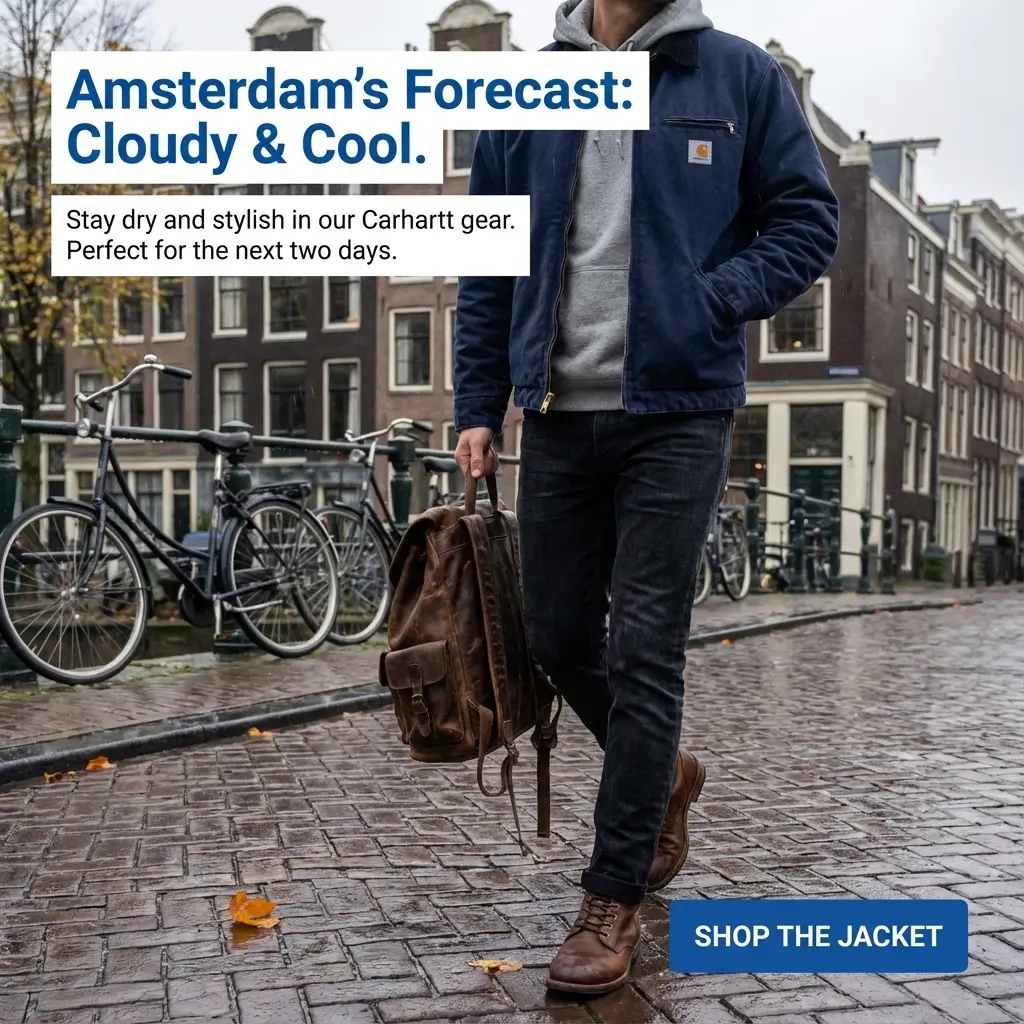
- The AI queried Google Weather → Found "Cloudy & Cool, Rain Expected"
- It analyzed the product feed → Rejected the t-shirt (too cold), rejected the sunglasses (no sun), selected the Carhartt Jacket
- It designed the ad → Placed the jacket in a moody Dutch street scene with rain
- It wrote the copy → "Stay dry and stylish" with weather-relevant messaging
The model didn't just generate an image. It made a strategic decision about which product to feature based on real-world conditions.
Step 4: The Output
The AI selected this jacket from the feed:

And turned it into this contextual ad for rainy Amsterdam:
One prompt. Zero manual curation. Real-time relevance.
Why This Matters: The Era of "Living" Ads
Okay, so this is a cool demo. But why should you care?
Banner Blindness is Dead
You know that feeling when you're scrolling and your brain just... skips over ads? That's banner blindness.
Generic ads get ignored because they're obviously not for you. They're showing sunglasses during a thunderstorm. Summer dresses in December. Completely disconnected from your reality.
But an ad that reflects your current situation? That breaks through.
Imagine seeing an ad for rain gear the moment you check your phone and see it's about to pour. That's not advertising. That's helpful. That converts.
From Tool to Employee
Here's the mental shift:
AI as a Tool (Old): You tell it exactly what to make. It makes it. Photoshop replacement.
AI as an Agent (New): You give it a goal and data access. It figures out what to make. Marketing strategist.
The agent workflow means marketers don't need to manually:
- Monitor weather forecasts in 50 cities
- Curate "Rainy Day" product collections
- Create location-specific ad variants
- Update campaigns when conditions change
The AI Agent handles all of this autonomously.
Scale That's Actually Impossible Otherwise
Let's be real: you can't manually Photoshop 1,000 ad variations for every weather pattern in every city.
You can't have a human monitoring sports scores to trigger celebration ads.
You can't react in real-time to stock market movements, trending topics, or breaking news.
But an AI Agent can.
It can monitor triggers 24/7 and deploy contextually perfect creative instantly.
Already need lifestyle images today? While we build AI agents, you can create lifestyle images for your products right now — transform any product photo into professional lifestyle scenes in seconds.


Different products. Same weather data. Different creative executions. All generated in seconds.
Here's what I'm envisioning for BackdropBoost users:
Imagine uploading your product catalog and clicking a button that says:
"Auto-Generate Daily Social Content Based on Trending Topics"
Or:
"Create Weather-Reactive Ads for All Target Regions"
Or even:
"Generate Event-Based Creatives When [My Sports Team] Wins"
That's the vision. You set the strategy. The AI Agent executes.
What's Next: From Image Generation to AI Agency
We're witnessing a shift in how AI integrates into marketing workflows.
Old World: You describe an image → AI generates it. You pick the products → AI executes. You update campaigns manually → AI follows orders.
New World: AI decides what to generate based on live context. AI selects the right products for the moment. AI updates creatives autonomously when conditions change.
The shift? From "Human strategist + AI executor" to "AI strategist + AI executor."
The technology exists today. The question is: who's going to implement it first?
The Trigger Types That Become Possible
With grounded AI agents, you can create ads that react to:
- Weather: Rain gear when it rains, sunscreen when it's sunny
- Sports: Team merchandise when your city's team wins
- Holidays: Automatic seasonal relevance without manual campaigns
- Stock Market: Investment-related products during market movements
- Trending Topics: React to viral moments in hours, not weeks
- Local Events: Concert merch when tours hit specific cities
- Time of Day: Morning coffee products at 7am, evening wine at 6pm
Every single one of these required manual campaign management before. Now? Set the trigger, let the agent run.
Your Next Steps
If You Want to Experiment Now
The technology is available through Google's Gemini API with tool use enabled. It requires:
- API access and authentication
- Understanding of function calling
- Infrastructure for real-time triggers
- Creative pipeline integration
It's doable if you have a developer. But it's not plug-and-play yet.
If You Want It Easy (Coming Soon)
We're building this into BackdropBoost. The goal is to make AI agency accessible without writing code:
- Upload your product feed (you already have this from Google Shopping)
- Set your triggers (weather, events, trending topics)
- Define your brand style (prompts and visual guidelines)
- Let it run (autonomous contextual ad generation)
Want to be first in line? Sign up for BackdropBoost and you'll get early access when we ship this.
The Bottom Line
We've moved from:
- "AI as a Photoshop replacement" → "AI as a Marketing Strategist"
- "Generate this image" → "Achieve this goal"
- "Static creative" → "Living ads"
I gave an AI permission to browse Google and make decisions about my product catalog. The results weren't just good—they were genuinely strategic.
This is Day 54. The future of marketing is getting built right now.
And honestly? It's absolutely bonkers.
Building something similar or want to chat about AI agents for marketing? Reach out at support@backdropboost.com. I'm always down to geek out about this stuff.
Related Resources
- Create Lifestyle Images for Products — Transform plain product photos into lifestyle scenes with AI, available today.
- 50 Prompt Ideas for Google Shopping — Proven prompts for scroll-stopping product photography.

About Alfred Simon
Co-Founder at BackdropBoost
Google Ads Expert • AI Entrepreneur
Hey there! I'm Alfred, a Google Ads expert turned AI entrepreneur. After years of managing Google Shopping campaigns and fighting for better performance, I built BackdropBoost to solve the image background problem that was driving me (and my clients) crazy.
With almost a decade of experience in Google Ads and managing hundreds of millions of dollars in ad spend, I know we need to take every opportunity to improve our campaigns. Back in the day we went down in the rabbit holes of SKAGs, adding bid adjustments to everything we could and creating waterfall Shopping campaigns.
Nowadays most of those things are automated. Now we have AI to play with and we need to use it to our advantage.
That is why I built BackdropBoost. With years of experience in Google Ads now I try to create tools that will help us, Google Ads experts, to find new opportunities to improve our campaigns.
Got questions about Google Shopping, AI image generation, or scaling e-commerce campaigns? I'd love to connect and chat!
🤖Explore this article with AI
Get AI-powered summaries, insights, and analysis from top AI platforms. Each platform offers unique perspectives on the content.
Related Resources
Ready to Transform Your Product Images?
Get 5 free credits to test our AI-powered background generator
Start Free Trial